The Simpsons Marge Death: Exploring the Rumors and That Shocking Future Episode
- Introduction to the Enduring Matriarch and ‘Estranger Things’
- Why the Rumors Persist: The Simpsons’ Unique Timeline
- The ‘Estranger Things’ Episode: A Glimpse 35 Years Ahead
- Fan Reactions and Producer Clarity on Marge’s Fate
- Other Notable Simpsons Character Deaths
- The Significance of Marge Simpson
- The Simpsons Marge Death: What It Means for Fans
The Simpsons Marge death is a topic that recently sent ripples through the show’s dedicated fanbase, sparking discussions and disbelief across social media. As a long-time viewer who’s seen nearly every episode (yes, even the later seasons!), I was genuinely surprised when headlines started popping up suggesting the iconic blue-haired matriarch had met her demise. It felt… wrong. Marge Simpson dying permanently seemed like an impossibility for a show known for its floating timeline and resistance to major, lasting character changes. This particular buzz stems from a recent episode, “Estranger Things,” in Season 36, which presented a future scenario where Marge is no longer with the family.
The idea of Marge Simpson, the glue that holds the chaotic family together, actually passing away is a pretty heavy concept. It goes against the very nature of *The Simpsons’* enduring, unchanging present. Yet, here we are, talking about a specific instance where her death was depicted. This isn’t the first time the show has played with future timelines, but portraying something as significant as Marge’s fate in the Simpsons universe understandably grabbed attention. It makes you wonder why the writers decided to go there, even in a non-canon future episode.
Why the Rumors Persist: The Simpsons’ Unique Timeline
For over three decades, *The Simpsons* has maintained a fascinating, almost bizarre, relationship with time. Characters don’t age in real-time, events from one episode are often contradicted in the next, and the status quo is almost always restored by the credits. This “floating timeline” or “elastic canon,” as producer Matt Selman calls it, is fundamental to the show’s longevity.
We’ve seen characters celebrate the same birthday multiple times, technological advancements appear and disappear, and historical events shift to match the current airing year. It’s a world where yesterday’s plot-driving event can be completely ignored tomorrow. This unique structure is precisely why the notion of a permanent Marge Simpson dying feels so alien to the show’s core identity.
Because of this fluid reality, fans have concocted countless theories over the years to explain the inconsistencies or explore darker possibilities. Some famous examples include theories about Homer being in a coma since a Season 4 episode, or complex analyses of character behavior suggesting hidden depths (or lack thereof, in Marge’s case, according to one theory about her having no friends). While these fan theories are fun, the show itself rarely commits to anything that would fundamentally alter its foundation. That’s what made the depiction of Marge’s fate in a future episode such a significant moment and fueled the recent rumors.
The ‘Estranger Things’ Episode: A Glimpse 35 Years Ahead
The episode that ignited this discussion about the Simpsons Marge death is the Season 36 finale, titled “Estranger Things,” which aired on May 18th. True to *The Simpsons*’ occasional practice of flash-forward episodes, this installment jumps ahead 35 years into the future. It focuses primarily on the estranged relationship between adult Bart and Lisa.
During a montage depicting how Bart and Lisa drifted apart, a poignant scene shows an elderly Homer weeping at Marge’s grave. The tombstone reads, “Beloved wife, mother, pork-chop seasoner.” Canadian musician Sarah McLachlan fittingly sings a parody of her song “When She Loved Me,” with lyrics acknowledging that Marge passed before Homer.
Later in the episode, Lisa discovers a video message Marge recorded before her death, urging her children to mend their relationship. In a typically surreal *Simpsons* twist, the episode concludes with Marge in the afterlife, seemingly married to Ringo Starr and heading to a “Heaven Buffet.”
This episode wasn’t a typical present-day Springfield story; it was a speculative look into *a* possible future. This distinction is crucial, as executive producer Matt Selman has emphasized that *The Simpsons’* future episodes are “speculative fantasies” and not part of a strict, overarching canon. So, while we saw Marge Simpson die in this future scenario, it doesn’t mean she’s permanently gone from the show’s primary timeline.
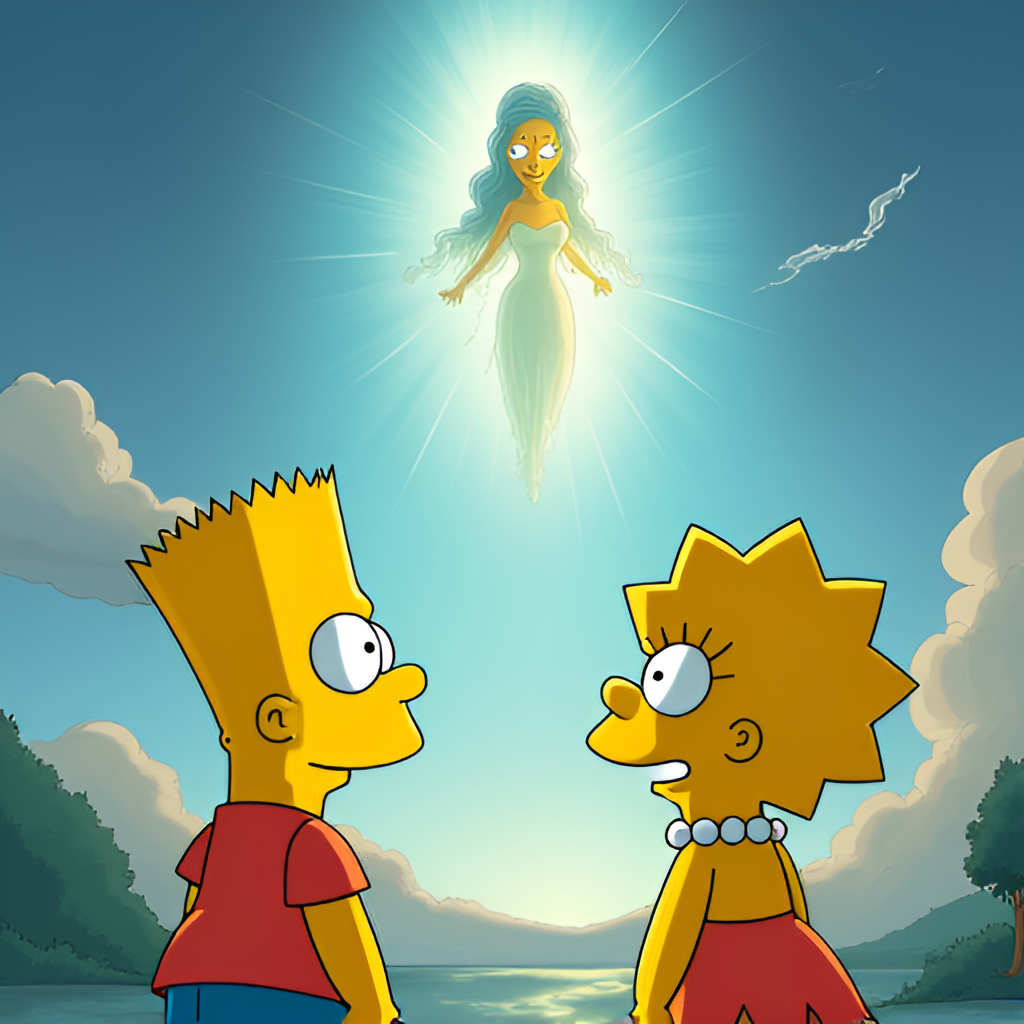
This image is a fictional image generated by GlobalTrendHub.
Fan Reactions and Producer Clarity on Marge’s Fate
Unsurprisingly, the depiction of Marge’s fate in the “Estranger Things” episode caused quite a stir among fans, leading to headlines proclaiming the character’s death. Social media lit up with reactions, ranging from shock and sadness to confusion and speculation. Many viewers, perhaps not fully grasping the non-canon nature of flash-forward episodes, genuinely believed the show had killed off one of its central characters.
Comments like “What do you mean they killed Marge Simpson?” and “Yo, they killed Marge off The Simpsons!?!?!?! What?!?!” flooded online platforms. This reaction underscores just how integral Marge is to the show’s identity and how unexpected a permanent character death, especially a main family member, would be.
In response to the fan outrage and confusion, *The Simpsons* executive producer Matt Selman addressed the issue, clarifying that the future depicted in “Estranger Things” is just one possibility and not definitive canon. He explicitly stated that “Marge will probably never be dead ever again” in the show’s main timeline, emphasizing that *The Simpsons* “doesn’t even have canon!”
Selman suggested that the media headlines surrounding Marge’s death were somewhat misleading, designed to generate traffic. However, he also noted that the strong reaction from fans demonstrates that people still care deeply about Marge and *The Simpsons*, which is ultimately good for the show. This producer clarity helps alleviate concerns that Marge Simpson dying is a permanent change, reinforcing the show’s long-standing approach to continuity.

This image is a fictional image generated by GlobalTrendHub.
Other Notable Simpsons Character Deaths
While *The Simpsons* family members rarely face permanent peril in the main timeline (Treehouse of Horror episodes notwithstanding), the show *has* killed off a number of recurring characters over its extensive run. These deaths have varied in their impact and reasons, sometimes serving a plot point and other times necessitated by the passing of a voice actor.
Perhaps the most impactful character death outside of the immediate family was that of Maude Flanders, Ned Flanders’ wife, who died in a bizarre t-shirt cannon accident in Season 11. Her death had lasting repercussions for Ned and his sons and is often cited as one of the show’s more tragic moments.
Other notable characters who have passed away include “Bleeding Gums” Murphy, Lisa’s jazz mentor, who died in Season 6 (though his spirit has reappeared) ; Fat Tony, the mob boss, who died of a heart attack in Season 22 (only to be replaced by his equally capable cousin, Fit Tony, who quickly became Fat Tony) ; and Edna Krabappel, Bart’s teacher, who was retired from the show following the death of her voice actress, Marcia Wallace, in 2013 (though her death was acknowledged and mourned in the show).
These instances show that *The Simpsons* is not entirely immune to character death, but they are typically supporting characters, and their passing is handled carefully, often with emotional weight or, in Fat Tony’s case, a darkly humorous continuation of their role. The idea of Marge’s fate in the Simpsons being sealed in the main timeline is a different magnitude entirely, which is why the flash-forward death caused such a reaction.
The Significance of Marge Simpson
Marge Simpson is far more than just Homer’s wife and the mother of Bart, Lisa, and Maggie. She is the moral compass of the family and, arguably, the most grounded character in Springfield.
My personal experience as a fan is that while Homer and Bart often drive the comedic chaos, and Lisa provides intellectual and emotional depth, Marge is the anchor. She embodies patience, perseverance, and an unwavering love for her deeply flawed family. Her signature beehive hairdo, her exasperated groan, and her attempts to maintain normalcy amidst the madness are all iconic elements of the show.
Marge represents a certain kind of everyday heroism – the quiet strength required to keep a household running and a family connected, despite constant challenges. The thought of Marge Simpson not being there is almost unthinkable for the show’s premise. Even in future-set episodes where her death is shown, her influence, like her video message to Bart and Lisa, continues to shape events.
Her character provides essential balance to the more outlandish personalities around her. Without Marge, the family dynamic fundamentally shifts. Her potential absence, even in a speculative future, highlights just how vital her presence is to the structure and heart of *The Simpsons*. It’s a testament to the character’s enduring significance that even a non-canon death could provoke such a strong reaction from viewers globally.
The Simpsons Marge Death: What It Means for Fans
So, what does “the Simpsons Marge death” ultimately mean for fans? At the end of the day, based on producer statements and the nature of the show’s continuity, it seems the depiction of Marge’s death in the Season 36 finale was a storytelling device for a flash-forward episode, not a permanent change to the main timeline. While the episode “Estranger Things” showed a future where Marge Simpson has passed away, this appears to be just one potential, non-canon future among many depicted throughout the series.
The strong reaction from the fanbase, however, speaks volumes. It shows that despite being on the air for decades and sometimes facing criticism for its later seasons, *The Simpsons* and its core characters, especially Marge, still hold a significant place in popular culture and in the hearts of viewers. The concern and discussion around Marge’s fate in the Simpsons highlight her irreplaceable role as the family’s emotional center and the show’s enduring ability to provoke strong feelings, even with a non-canonical plot point. We can likely expect Marge to continue being her wonderfully exasperated, loving self in Springfield for many seasons to come.
Disclaimer: Information regarding future episodes or character fates is based on currently available reports and may be subject to change or interpretation within the show’s unique narrative style.
External Resources:
- Stream The Simpsons on Hulu – (Link to a platform where the show can be watched)
- The Simpsons Wiki – (Link to a comprehensive fan resource)